NPL Technical Review Finds EVCI Methodology Suitable for Real-World EV Charger Accuracy Assessment
Independent assessment of EVCI’s reference equipment, cable-loss analysis and field methodology, completed under NPL’s Measurement for Business programme.
EVCI’s electric vehicle charger accuracy assessment methodology has completed an independent technical review by the National Physical Laboratory (NPL), the UK’s national measurement institute.
Conducted through NPL’s Measurement for Business programme, Project 20385 examined the performance of EVCI’s reference measurement equipment, the potential impact of charging-cable losses and the methodology’s suitability for use under real-world charging conditions.
The report concludes: “EVCI have demonstrated a measurement system suitable for real-world EV charger accuracy assessment, providing independent technical evidence that is suitable for assessment against the MID Class A ±2% threshold.”
Assessment of EVCI’s reference equipment
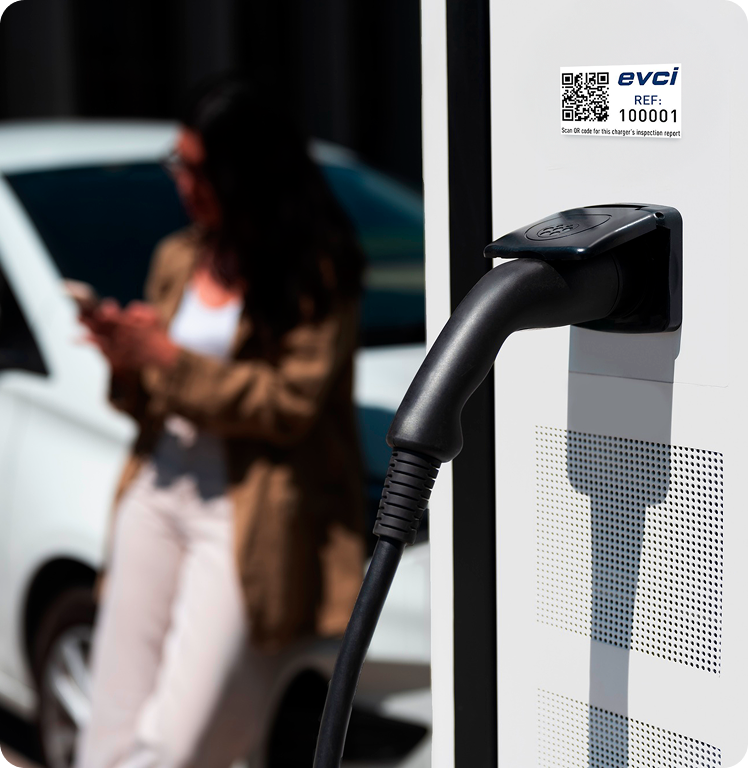
EVCI conducts its field assessments using a calibrated reference measurement system positioned between the EV charger and the vehicle. This enables EVCI to independently compare the energy reported by the charger with the energy measured at the charger connector during a genuine vehicle-charging session.
As part of its review, NPL independently assessed the voltage and current measurement capabilities of the equipment across DC voltages from 200 V to 950 V and charging currents from approximately 15 A to 300 A.
The recorded voltage measurement ratios ranged from 0.99988 to 1.00002, equivalent to differences of approximately −0.012% to +0.002%. NPL calculated a voltage measurement uncertainty of ±24 parts per million at 95% confidence.
At an example operating point of 300 A and 400 V, NPL calculated a combined power measurement ratio of approximately 0.99990, with an uncertainty of ±356 parts per million. This remained comfortably within the reference equipment’s stated 0.1% accuracy specification.
Real-world charger testing
The review also examined whether EVCI’s use of an electric vehicle as the charging load could provide reliable and repeatable measurements across different charging powers and vehicle states of charge.
NPL witnessed measurements at locations equipped with MID-approved charging meters and at chargers where significant accuracy discrepancies have been suspected.
During testing against an MID-approved charger meter, the maximum recorded difference between EVCI’s reference equipment and the charger meter was 0.12%, at a charging power slightly above 20 kW.
Testing also confirmed that charging power can vary considerably as the vehicle’s battery state of charge increases. The review found that conducting assessments between approximately 20% and 80% state of charge provides the strongest measurement repeatability.
Charging-cable losses
NPL also investigated the potential impact of electrical losses within high-current EV charging cables.
Using laboratory measurements scaled to represent a typical pair of 50 mm², 10-metre charging conductors, the assessment estimated that a charger operating at 500 A and approximately 200 kW could experience cable losses of around 0.34%, equivalent to approximately 680 watts.
Where a charger’s billing meter does not adequately account for losses between the meter and the point of delivery, these losses could contribute towards the charger moving outside its permitted accuracy tolerance. The effect may increase as cables, connectors and other components deteriorate and electrical resistance rises.
Building confidence in public EV charging
Craig Marsden, Chief Executive Officer of EVCI, said:
“Independent verification has always been fundamental to EVCI’s approach.
“Having our equipment and field methodology independently reviewed by the National Physical Laboratory provides important technical evidence that our assessments are suitable for real-world charger accuracy testing.
“Drivers should be confident that the kilowatt-hours they pay for are the kilowatt-hours they receive. This review strengthens the evidence behind our work with charge point operators, manufacturers, fleets and policymakers to improve transparency and confidence across the public charging network.”
EVCI assesses public EV chargers at the charger connector using calibrated reference equipment and genuine vehicle-charging sessions.